Free shipping above £ 25
 2 working day delivery
 Pay in 3 installments







Firewood price trends in 2026: what's the outlook?
Updated: 27 August 2026
Why is firewood so expensive right now?
We completely get it: it's frustrating to see the price of a cosy, warming fire stay high in 2026 as well. At Firewood Giant we believe in being honest and straightforward, so here's the plain explanation. The short version: wood purchase prices have climbed sharply again this year, and the figures show exactly how much.
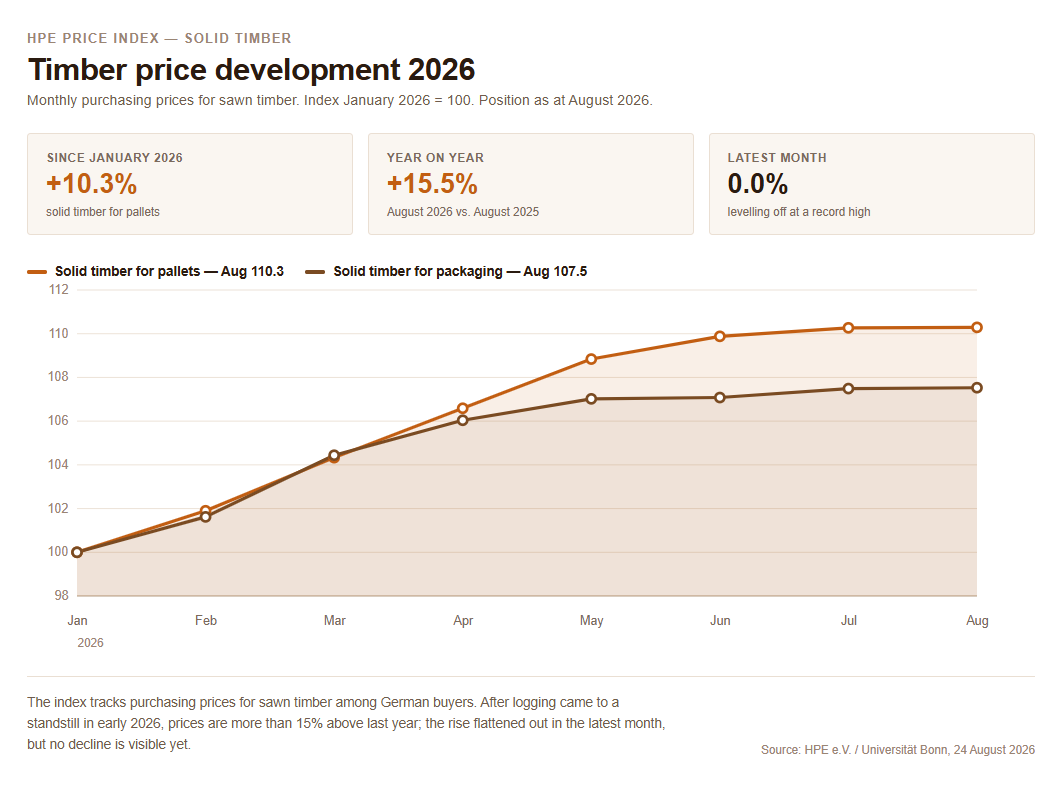
According to the HPE price index, a leading index for the purchase price of softwood, the price of solid wood in August 2026 was around 10% higher than in January. Year on year, that's a rise of nearly 15%. Below we explain the four factors behind it, and what you can do about it.
In short: the wood market in 2026
For anyone who wants the quick version, here are this year's main price drivers:
|
Factor |
Impact on the current wood price |
|---|---|
|
Disrupted supply from producing countries |
Less fresh timber reaching the sawmills, tighter supply at the start of the chain. |
|
Production backlogs |
Demand outstrips the dried wood that's ready to ship. |
|
High energy prices |
Households turn to wood heating for security, which pushes demand up. |
|
High transport costs |
Moving heavy wood from Eastern Europe to the UK stays expensive. |
1. Disrupted supply from the producing countries
The main wood-producing countries in Eastern and Northern Europe faced a harsh winter at the start of 2026. Exceptional snowfall, frozen ground and prolonged cold left forests barely accessible to heavy machinery for weeks. As a result, felling largely ground to a halt, which cut the supply of fresh timber reaching the sawmills.
Less supply at the start of the chain inevitably means higher prices at the end. And you can see it in the figures: it was in the first quarter of 2026 that purchase prices rose fastest.
2. Clearing a big backlog in the supply chain
That standstill created a considerable production backlog. Sawmills have been working flat out ever since to clear the shortfall, but with firewood there's a catch: wood has to dry before it can go in your stove. Even with modern kilns, that takes time and energy. The directly usable, dry supply simply isn't large enough to keep up with market demand comfortably, and that shortage of available wood drives purchase prices up.
You can see how this plays out in the chart below. It's based on the HPE price index, which tracks softwood purchase prices every month (a good barometer for the wider wood market). We've set January 2026 to 100, so you can see at a glance how much the price has risen since the start of the year.
Source: HPE price index (hpe.de)
What stands out: prices climbed hardest in the first half of the year. Solid wood for pallets reached just over 110 points in August (+10% since January), packaging wood just over 107 points (+7.5%). Over the summer months the rise flattens off, but there's no sign of a real drop. Prices are settling at a high level.
3. Rising energy prices are driving demand for firewood
Energy and gas prices remain a worry for many households in 2026. The response is understandable and predictable: people look for reliable, alternative sources of heat to keep their costs under control. The stove or open fire is still one of the most popular choices. This sustained high demand for firewood from households puts extra pressure on already tight supplies across Europe.
4. The direct effect of transport costs
Firewood is heavy and takes up a lot of space. Transport costs therefore always make up a substantial part of the final sale price. The lorries that bring our pallets of firewood safely and dry from Eastern Europe to the UK have become more expensive over the past few years, and those costs have to be passed on in part to the final price of a pallet of wood. As long as fuel and transport stay expensive, this keeps feeding into what you pay for a pallet.
There's been added pressure lately from road tolls too. On the journey across Europe, the German Maut now applies to virtually all freight traffic, having recently been widened to include a CO2 charge and lighter lorries, and here in the UK the HGV road user levy applies to haulage on our own roads. Those tolls land on top of an already high diesel price, and both feed straight into transport costs.
Historical perspective: the aftermath of the crisis years
Looking back, there's a clear thread running through wood prices over recent years:
- 2021 to 2022: an explosive price rise driven by pandemic-related shortages, logistical problems and the fallout from the war between Russia and Ukraine (including sanctions and import bans).
- 2023 to 2024: a slight stabilisation, with the market settling into a new but lastingly higher 'normal'.
- 2025 to 2026: on top of the ongoing effects of changed import flows across Europe (many countries are keeping wood within their own borders), disrupted supply and sustained demand are now driving another price peak.
The wood market is still a long way from its pre-pandemic stability and remains sensitive to outside factors.
Outlook for the rest of 2026: what's the best move?
Waiting for a significant price drop doesn't look like a sensible strategy in this market. The figures do show a levelling-off over the summer, but no fall, and once the heating season gets going again demand traditionally rises. So the odds are that prices will climb rather than ease once the rush returns.
Our advice is simple: get ahead of the crowd. Don't wait until prices possibly rise further or lead times stretch out. Order your supply of kiln dried logs or heat logs from Firewood Giant today. That way you're assured of top-quality wood, you'll stay nice and warm this year, and you'll avoid any nasty surprises later in the season.